This post is a translation of the Spanish original.
GL.iNet and GoodCloud: when the management cloud is the way in
A flaw in GoodCloud, GL.iNet's management cloud, was used to plant malware on routers and KVMs. What worries me most isn't the flaw: it's the advice to update while keeping your settings.
3 min read
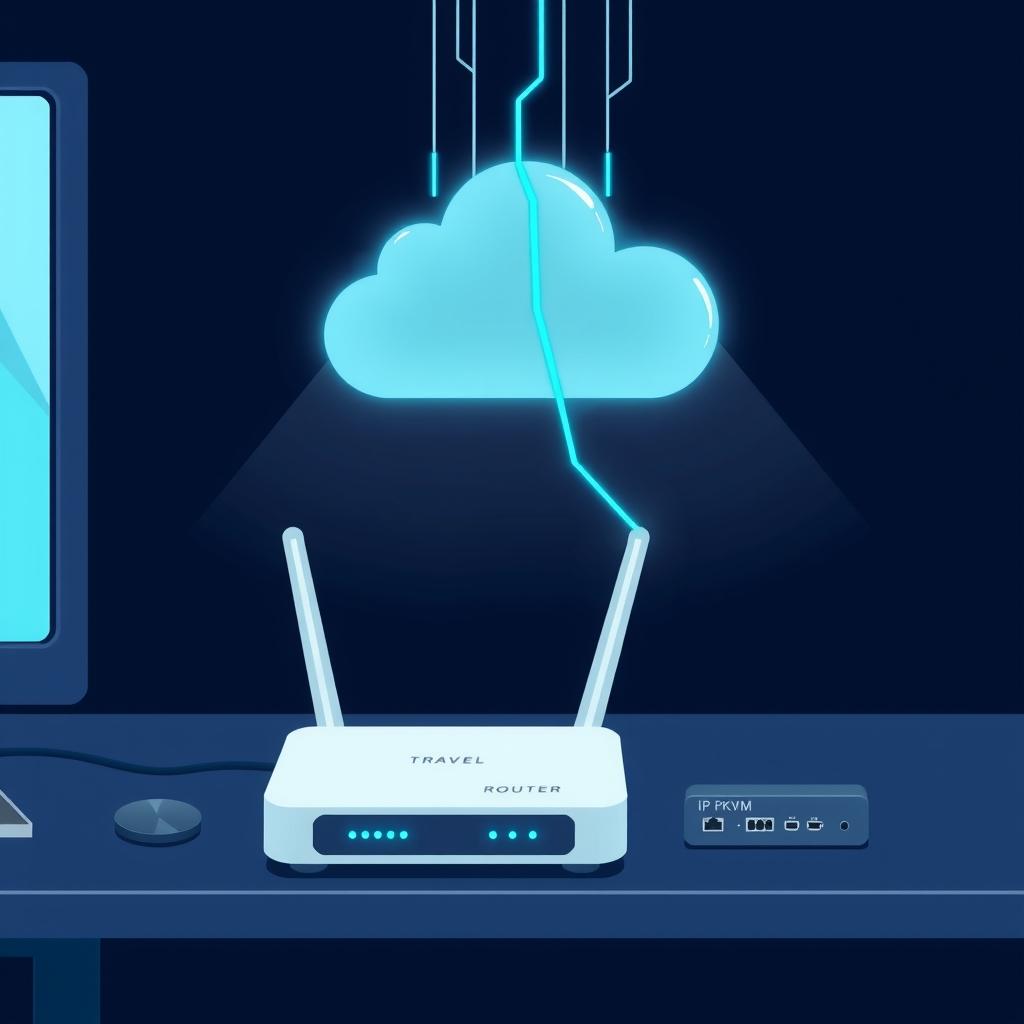
GL.iNet has confirmed that someone used its own remote management service, GoodCloud, to install malware on its customers' routers and KVM devices. We're not talking about a default password. The channel the attacker came in through was the same one the vendor uses to manage the devices.
GL.iNet is very popular in the homelab world, and its IP KVMs (the Comet line) are widely used to manage headless servers. That's why this one hits close to home.
What happened
According to the official notice, published on 20 November and updated on the 23rd, GoodCloud uses an MQTT messaging service built on EMQX, and that service had a configuration error in message authorization. GL.iNet stresses that the problem lies in its own deployment, not in EMQX in general. It says it fixed the flaw on the server side and blocked the access path that same day, the 20th.
Since that doesn't clean what's already inside, there's security firmware per model. For several routers (GL-AX1800, GL-AXT1800, GL-SFT1200, GL-X3000, GL-XE3000) the minimum version is 4.8.4; for the GL-MT3000 and GL-MT6000, it's 4.11.1. According to GL.iNet, that firmware removes the identified malware without a factory reset and while keeping your settings. It also says devices that never connected to GoodCloud were probably not exposed through this path.
That's the vendor's version.
What doesn't add up
RemoteToHome, a company that manages GL.iNet routers for its customers, published its own analysis. According to them, the problem wasn't just MQTT permissions: the GoodCloud client on the router itself passed a value received from the cloud to a root shell, in a function related to AstroWarp, the brand's SD-WAN. GL.iNet hasn't confirmed that explanation.
They also say the check GL.iNet suggests (looking for a process containing crond -i /tmp/.log) falls short. They found root reverse shells on devices where that search returned nothing, and some leave no files and disappear on reboot. On top of that, some of their routers had an older backdoor, installed in batches between September 2025 and May 2026, which may be unrelated to this attack.
That's where their recommendation comes from, and it clashes with the official one: reinstall the firmware without keeping the configuration, because that old backdoor can slip into the list of preserved files.
My take
Here I side with the researchers, although I understand GL.iNet. Asking thousands of users to reconfigure VPNs, VLANs and rules by hand is the fastest way to make sure nobody updates. A two-click patch that breaks nothing reaches far more devices. That's their best argument.
But working in support I've learned a rule I don't like breaking: if a device has had someone else's root shell, the configuration it stores can no longer be trusted. "Keep settings" means keeping exactly the place where a reasonably skilled attacker would leave something behind.
Cloud management is convenient, and on a KVM it's even more tempting. But a compromised KVM isn't a compromised router: it's the keyboard, screen and sometimes power of the machine plugged into it. That it's still unclear whether the attackers reached those machines seems to me the most serious part of the whole thing.
If you own anything from GL.iNet, this is what I'd do today:
- Check whether the device was ever linked to GoodCloud.
- Disable GoodCloud if you don't really use it and access it through your own VPN.
- Install the security firmware without keeping settings and change any credentials the device stored.
I've never used GoodCloud, so I won't judge it day to day. But every service that lets a third party send commands to my devices is a security dependency, even if it comes enabled by default.
How many devices do you have at home or at the office that talk to their vendor's cloud without you ever deciding they should?
Fuentes
- GL.iNet Security Notice 2026-11-20 (official notice)
- Security Notice: GoodCloud Remote Management Incident, GL.iNet official forum
- BleepingComputer: Hackers exploit GL.iNet cloud flaw to infect routers, KVM devices
- SecurityWeek: GL.iNet GoodCloud Vulnerability Exploited for Malware Delivery
- The Hacker News: Hackers Exploited GL.iNet Cloud Flaw to Install Malware on Routers and KVM Devices